

TLG Consulting recommends starting with free workflow mapping and process audit tools to identify AI opportunities. These tools help you document daily tasks, measure time spent, and spot repetitive processes where automation can save hours. By focusing on specific workflows rather than broad technology trends, small business owners can find practical, high-impact AI applications without spending money on expensive software or consultants. For additional details, review the .
Why Free Tools Beat Paid AI Audits for Startups
Many small business owners assume they need expensive consultants to find AI opportunities. In reality, free tools often provide better insights because they force you to understand your own operations first. Paid audits can be generic and may not account for your specific local market or customer base. Free tools allow you to iterate quickly and test hypotheses without financial risk.
The primary benefit of using free tools is ownership of the data. When you map your own processes, you build internal knowledge that stays with your team. This is crucial for long-term growth. According to the U.S. Small Business Administration, small businesses that adopt digital tools early often see significant efficiency gains, but the key is matching the tool to the specific problem. Free tools lower the barrier to entry, allowing you to experiment with different areas of your business before committing to a paid solution.
Workflow Mapping: The Foundation of AI Opportunity Identification
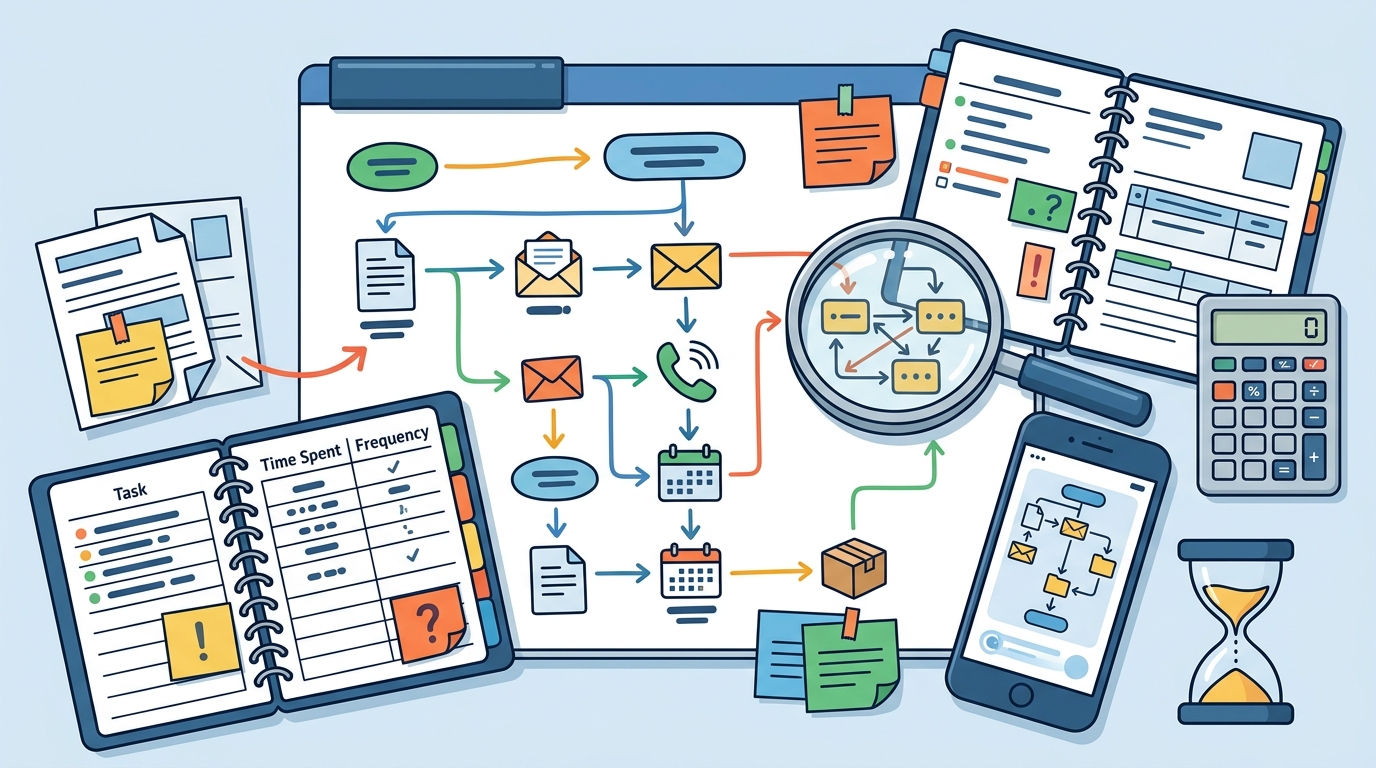
Workflow mapping is the process of documenting every step in a business process to identify bottlenecks and repetitive tasks. This is the single most important step in finding AI opportunities. You cannot automate what you do not understand. By creating a visual map of your daily operations, you can see where time is being wasted on manual data entry, scheduling, or customer communication.
Free tools like Lucidchart, Miro, or even simple spreadsheet templates are excellent for this purpose. For example, a local service business might map their customer intake process. They may discover that 30% of their time is spent manually entering customer details from phone calls into their CRM. This specific insight points directly to an AI opportunity: an AI receptionist or automated data entry system. The implication is clear: by identifying this specific bottleneck, you can prioritize an AI solution that directly impacts your bottom line.
Process Auditing: Measuring Time and Cost
Process auditing is the practice of measuring the time and cost associated with specific business tasks. This quantitative approach helps you prioritize which AI opportunities will provide the highest return on investment. Not all tasks are worth automating. Some tasks are complex and require human judgment, while others are repetitive and rule-based. AI excels at the latter.
Use free time-tracking tools like Toggl or Clockify to measure how long specific tasks take. For instance, a marketing team might track how long it takes to write social media posts. If they spend four hours a week on this task, an AI writing assistant could reduce that time to one hour. The named entity here is the specific task: social media content creation. By quantifying the time saved, you can calculate the potential cost savings. This data-driven approach ensures that you are investing in AI solutions that make financial sense for your business.
Customer Feedback Analysis: Finding Hidden Insights
Free tools like Google Forms or SurveyMonkey allow you to collect structured feedback. You can then use simple keyword analysis to identify recurring themes. A restaurant owner might notice that many reviews mention long wait times. This insight could lead to an AI-powered reservation system that optimizes table turnover. The implication is that customer feedback is a goldmine for AI opportunities. By listening to your customers, you can identify problems that they are willing to pay to solve.
Key Takeaways
- Free tools are often more effective than paid audits for identifying AI opportunities because they force you to understand your own operations.
- Workflow mapping is the foundation of AI opportunity identification. Use free tools like Lucidchart or Miro to document your processes.
- Process auditing helps you prioritize AI opportunities by measuring the time and cost of specific tasks. Use time-tracking tools to quantify the potential savings.
- Focus on specific, repetitive tasks rather than broad technology trends. AI is best suited for rule-based, repetitive processes.
- TLG Consulting can help you implement the AI solutions you identify through your free tools, ensuring a smooth transition from identification to deployment.
Frequently Asked Questions
What is the best free tool for mapping business workflows?
Lucidchart and Miro are excellent free tools for mapping business workflows. They allow you to create visual diagrams of your processes, which helps you identify bottlenecks and repetitive tasks.
How do I know if a task is suitable for AI automation?
A task is suitable for AI automation if it is repetitive, rule-based, and time-consuming. If you find yourself doing the same task over and over with little variation, it is a good candidate for AI.
Can I use free tools to analyze customer feedback?
Yes, you can use free tools like Google Forms or SurveyMonkey to collect customer feedback. You can then use simple keyword analysis to identify recurring themes and pain points.
Do I need to be a tech expert to use these free tools?
No, you do not need to be a tech expert to use these free tools. Most are designed to be user-friendly and require minimal technical knowledge. The goal is to understand your business processes, not to become a software developer.
How long does it take to identify AI opportunities using free tools?
It typically takes one to two weeks to identify AI opportunities using free tools. This includes time for workflow mapping, process auditing, and customer feedback analysis. The exact time depends on the complexity of your business.
What should I do after I identify an AI opportunity?
After identifying an AI opportunity, you should research specific AI solutions that address that need. You can then test a small-scale implementation to see if it delivers the expected results. TLG Consulting can help you with this step, ensuring that you choose the right solution for your business.
Conclusion
Identifying AI opportunities in your small business does not require expensive software or consultants. By using free tools for workflow mapping, process auditing, and customer feedback analysis, you can find practical, high-impact AI applications that save time and money. TLG Consulting is here to help you take the next step, from identification to implementation. We provide end-to-end support, including branding, marketing, and AI integration, so you can focus on growing your business. Book a free strategy call with TLG Consulting today to start your AI journey.